

Securing Fruit Production in a Drought-Filled Future:
The Role of Surface Water Catchment for the Small Scale Producer by Steven Stup
Problem
Drought hinders our capacity to secure two fundamental necessities: water and food production. A farm’s ability to endure climate-related extremes will involve learning how to adapt to a constantly moving target. Finding opportunities to engineer and implement climate-resilient practices will be the key to securing fruit production for generations to come.
Due to its substantial reliance on stored soil water, the agricultural sector is typically the first to be impacted when a drought begins. Soil water can be rapidly depleted during periods of extended dry. The longer growing crops, including trees and small fruits, cannot produce profitably under arid conditions without the artificial application of water (irrigation). However, prolonged draw from groundwater reserves (aquifers) can lead to limited supplies for people, emerging industries, and the local ecology. Since our farm in Damascus, MD (Montgomery County) is located over the Piedmont Sole Source Aquifer (recharged solely by precipitation & snow melt events), our access to water resources is finite. We are aware of this limited resource and are actively pursuing ways to sustain its abundance.
Farmers take a variety of adaptive actions in response to drought, such as surface water catchment, adding drainage or irrigation systems, season extension in protected growing conditions, crop diversification, and ecological production practices that build moisture-retentive soil. We are going to focus our attention on the role of surface water catchment, along with a framework of how a farm can add simple, budget & climate-friendly structures (rainwater harvesting cribs) to help increase their holding capacity to withstand prolonged weather-related events.
Solution
Focusing on our ability to capture (harvest) rainwater is often an overlooked practice, serving only those in arid regions with minimal annual rainfall percentages. Tap into the minds of dry farmers & we begin to get creative with one of the Mid-Atlantic’s most abundant resources: precipitation events.
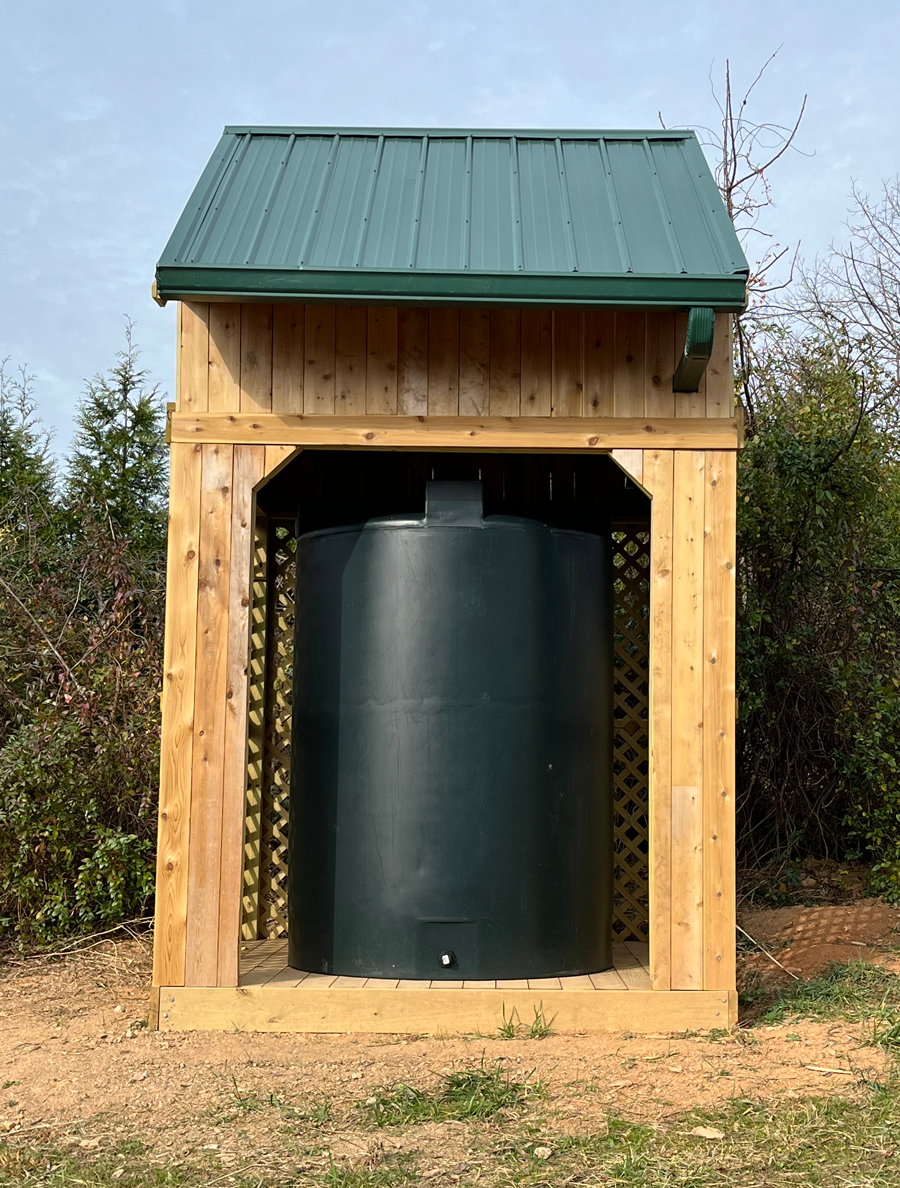
Montgomery County, MD averages +- 42” of rainfall per year, which means (1) a single 1150g tank with an 8’x8’ roof has the capacity to store upwards of 2000g of water per year. Enough water to sustain a maturing block of fruit-bearing plants or establish a young grove of fruit trees during times of prolonged drought. Start to link additional rainwater harvesting cribs together, and you have a surface water catchment system that utilises rainwater caught, stored, & dispersed across a growing block with any excess redirected back into the local watershed.
One of the best parts of surface water catchment is that there are only (2) items necessary to harvest rainwater. 1) a surface to collect precipitation and 2) a location to store harvested rainwater.
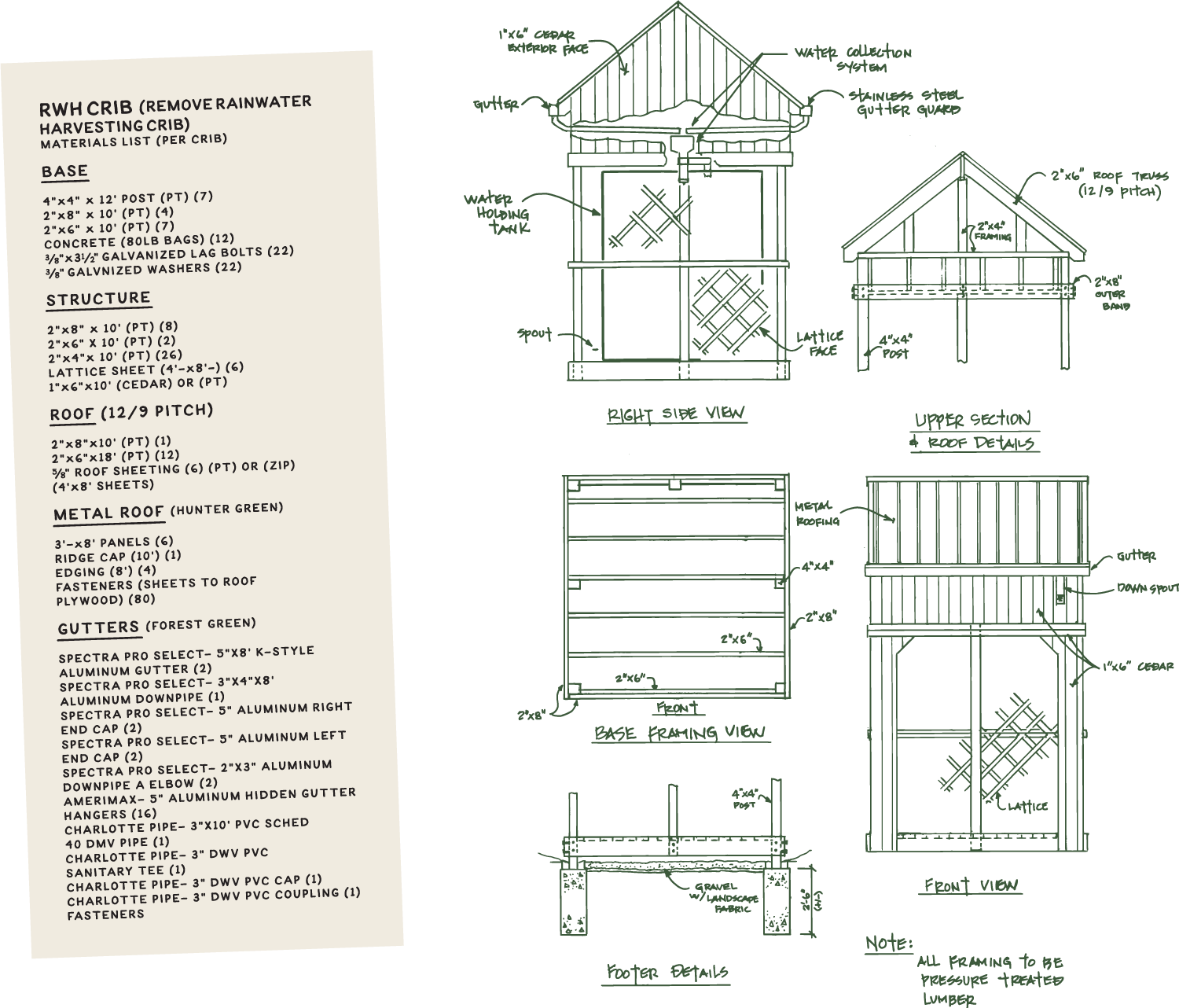
That is exactly what the RWH crib is modelled after. Utilizing materials found in local building supply yards, along with intermediate carpentry skills, one individual can complete a rainwater harvesting crib and begin to become more climate resilient as soon as the next precipitation event occurs.
Our goal with the RWH crib design is to allow scaling at any capacity. Since we are starting from raw land, we needed to focus our attention on infrastructure that provides flexibility for future expansion. An example of this would be positioning of the cribs (hilltop) to utilize gravity-fed irrigation, or adding a power source to charge the system to add pumps, automation, etc.
So, what is the role of surface water in small-scale fruit (or specialty crop) production?
Long-term: The Growing operation becomes a part of the larger water cycle. Taking from groundwater (aquifer) is resupplied from an abundance of precipitation events, which diverts & refills the groundwater aquifer once the RWH crib reaches capacity.
The farm no longer takes water resources without the potential of replacement to help extend the life of the local ecology.
Short-term: To supplement the main source of irrigation water (aquifer (well), pond, municipal) for orchard or fruiting plant block establishment during periods of drought.
Adding surface water catchment allows the grower a chance to store water from precipitation events for precision application when required during periods of drought.
Conclusion
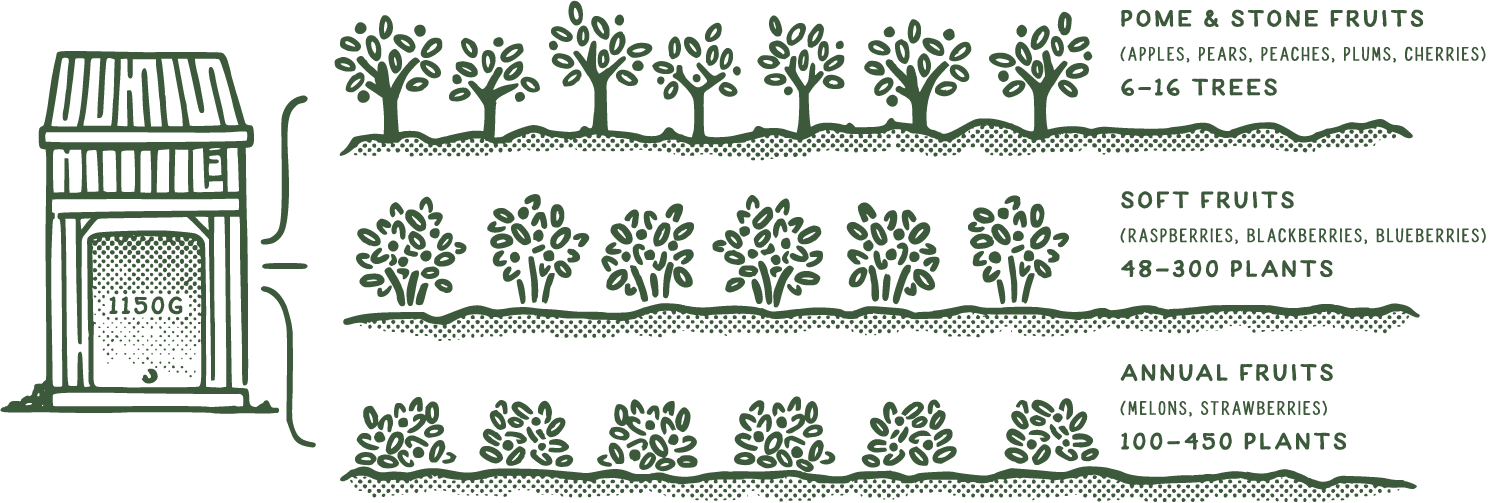
Ultimately, the successful management of agricultural production systems will be determined by the willingness and ability (of the farmer) to take action to reduce climate-related risk. Although they may seem complicated, sustainable climate-friendly solutions can function almost automatically when correctly integrated with other/existing agricultural systems. Coupling efficient irrigation practices (drip) with a stored surface water source, powered by a solar array, roof-mounted on an RWH crib, provides an opportunity to disperse water directly where needed across a field with only renewable resources. That seems like a win (crops)-win (farmer)-win (ecosystem) to me on my farm. Below is a visual breakdown of the potential quantity of fruits a single RWH crib can sustain during periods of inadequate precipitation events.
Crop Yield Calculations
Yield calculations are noted based on soil composition, row spacing, rootstock selected, and water management practice for each fruit type. The 1150 Gallons only covers one weekly watering cycle. You will need a consistent way to refill the tank for subsequent waterings throughout the growing season (varies with rainfall consistency).
Block #1: Pome Fruits (Apples + Pears)
Apples:
Soil Composition: Linganore-Hyattstown channery silt loams (3-8% slopes)
- Row Spacing: 4’(w) x 16’(tree spacing) x 50’(l) with 20’between rows
Total Rows Irrigated: 2-3
- Rootstock Selected: B.118 (Semi-Standard)
Total Trees Irrigated: 6-9 (3 trees per row)
Water Management*: 1150 g Rainwater Catchment Tank w/gravity-fed, drip irrigation offering 0.5-1GPH, once per week with the full 1150-gallon water tank.
Pears:
Soil Composition: Linganore-Hyattstown channery silt loams (3-8% slopes)
- Row Spacing: 4’(w) x 18’(tree spacing) x 50’(l) with 22’between rows
Total Rows Irrigated: 2-3
- Rootstock Selected: OHxF97 (Standard)
Total Trees Irrigated: 6-9 (2 trees per row)
Water Management*: 1150 g Rainwater Catchment Tank w/gravity-fed, drip irrigation offering 0.5-1GPH, once per week with the full 1150-gallon water tank.
Block #2: Stone Fruits (Peaches, Plums, Cherries)
Peaches:
Soil Composition: Linganore-Hyattstown channery silt loams (3-8% slopes)
- Row Spacing: 4’(w) x 12’(tree spacing) x 50’(l) with 18’between rows
Total Rows Irrigated: 3-4
- Rootstock Selected: BY560-9 (Standard)
Total Trees Irrigated: 12-16 (4 trees per row)
Water Management*: 1150 g Rainwater Catchment Tank w/gravity-fed, drip irrigation offering 0.5-1GPH, once per week with the full 1150-gallon water tank.
Plums:
Soil Composition: Linganore-Hyattstown channery silt loams (3-8% slopes)
- Row Spacing: 4’(w) x 12’(tree spacing) x 50’(l) with 18’between rows
Total Rows Irrigated: 3-5
- Rootstock Selected: Myrobalan (Standard)
Total Trees Irrigated: 9-15 (3 Trees Per Row)
Water Management*: 1150 g Rainwater Catchment Tank w/gravity-fed, drip irrigation offering 0.5-1GPH, once per week with the full 1150-gallon water tank.
Cherries:
Soil Composition: Linganore-Hyattstown channery silt loams (3-8% slopes)
- Row Spacing: 4’(w) x 16’(tree spacing) x 50’(l) with 20’between rows
Total Rows Irrigated: 2-3
- Rootstock Selected: Mahaleb (Standard)
Total Trees Irrigated: 6-9 (3 Trees Per Row)
Water Management*: 1150 g Rainwater Catchment Tank w/gravity-fed, drip irrigation offering 0.5-1GPH, once per week with the full 1150-gallon water tank.
Block #3: Soft Fruits (Raspberries, Blackberries, Blueberries)
Raspberries:
Soil Composition: Linganore-Hyattstown channery silt loams (3-8% slopes)
- Row Spacing: 4’(w) x 2’(cane spacing) x 50’(l) with 8’between rows
Total Rows Irrigated: 10-12
- Rootstock Selected: Nursery Stock
Total Plants Irrigated: 250-300 (25 plants per row)
Water Management*: 1150 g Rainwater Catchment Tank w/gravity-fed, drip irrigation offering 0.5-1GPH, once per week with the full 1150-gallon water tank.
Blackberries:
Soil Composition: Linganore-Hyattstown channery silt loams (3-8% slopes)
- Row Spacing: 4’(w) x 4’(cane spacing) x 50’(l) with 8’between rows
Total Rows Irrigated: 4-9
- Rootstock Selected: Nursery Stock (Thorny/Thornless Upright & Trailing)
Total Plants Irrigated: 48-108 (12 plants per row)
Water Management*: 1150 g Rainwater Catchment Tank w/gravity-fed, drip irrigation offering 0.5-1GPH, once per week with the full 1150-gallon water tank.
Blueberries:
Soil Composition: Linganore-Hyattstown channery silt loams (3-8% slopes)
- Row Spacing: 4’(w) x 4’(bush spacing) x 50’(l) with 8’between rows
Total Rows Irrigated: 4-9
- Rootstock Selected: Nursery Stock
Total Plants Irrigated: 48-108 (12 plants per row)
Water Management*: 1150 g Rainwater Catchment Tank w/gravity-fed, drip irrigation offering 0.5-1GPH, once per week with the full 1150-gallon water tank.
Block #4: Annual Fruits (Melons + Strawberries)
Melons:
Soil Composition: Linganore-Hyattstown channery silt loams (3-8% slopes)
- Row Spacing: 4’(w) x 2’(plant spacing) x 50’(l) with 6’between rows
Total Rows Irrigated: 4-8
- Rootstock Selected: Seedling
Total Plants Irrigated: 100-200 (25 plants per row)
Water Management*: 1150g Rainwater Catchment Tank w/gravity-fed, drip irrigation offering 0.5-1GPH, once per week with the full 1150-gallon water tank.
Strawberries:
Soil Composition: Linganore-Hyattstown channery silt loams (3-8% slopes)
- Row Spacing: 4’(w) x 1’(plant spacing) x 50’(l) with 6’between rows
Total Rows Irrigated: 4-9
- Rootstock Selected: Seedling / Bare-root
Total Plants Irrigated: 200-450 (50 plants per row)
Water Management*: 1150 g Rainwater Catchment Tank w/gravity-fed, drip irrigation offering 0.5-1GPH, once per week with the full 1150-gallon water tank.